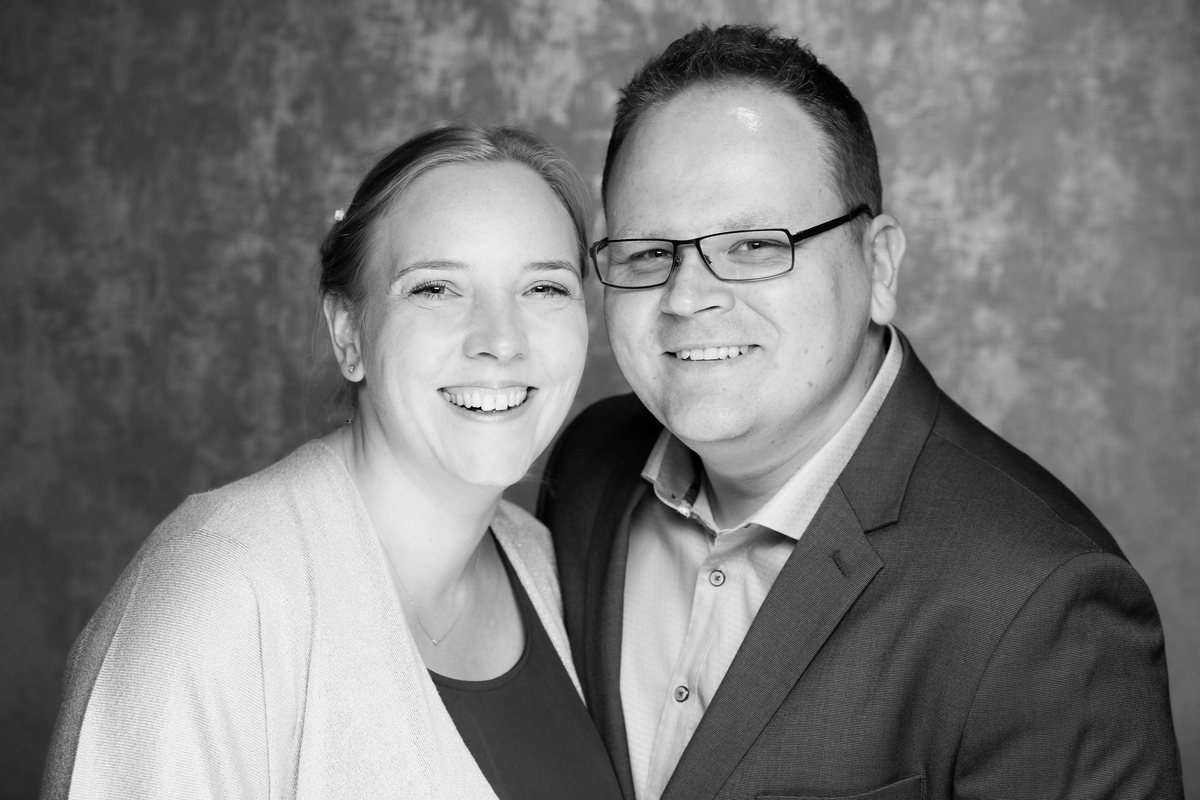
Me (Sarah) with my husband Siegfried — the people behind mypacing.
I'm Sarah. Long COVID took my life away from me — and I know exactly how that feels.
mypacing wasn't built in an office. It grew at our kitchen table — on the rare good days, and on the many days I couldn't even make it to the sofa without paying for it for days afterward. I'm not writing about an illness I read about somewhere. I carry it inside me, every single hour, for more than three years now. My husband Siegfried was there from the first terrible night, held my hand when I was too exhausted to speak — and helped me build what I'm telling you about here.
Maybe you know the feeling: your body no longer does what it's supposed to. Something that used to be completely ordinary — shopping, a phone call, the stairs up to your own front door — suddenly costs everything you have, and then some. You keep smiling, keep standing upright, while everything inside you is already shaking and screaming to stop. And if you do it anyway, because life is supposed to go on somehow, the bill arrives — not right away, but days later, when you can barely open your eyes, when even a single sentence feels like hard labour and every sound, every bit of light, is too much. That's exactly where it all started for me. And I remember every single day of it, as clearly as if it were yesterday.
Before
I rode motorcycles, I went diving, I travelled. I was right in the middle of life and work — I worked in the city treasury, 39 hours a week, never really thinking that strength was something that could run out. A normal, active life with plans, with a future I took as much for granted as my next breath.Today
Most of that is gone. Some days are made up of nothing but pauses between short walks, of silently calculating how much strength is left before it tips over. The motorcycle sits idle, gathering dust in the garage — I can barely even look at it without it hurting. My further training, two years of work, so close to the finish line, I had to abandon. Some mornings I don't know which version of me is going to wake up.Then came COVID — three times
In 2022 I had COVID three times, plus bronchitis over Christmas. I didn't think much of it. I thought: this will pass, the way it always has. But it didn't pass. From early 2023 on, a wave of symptoms came over me that simply wouldn't stop, that got worse week by week: a leaden exhaustion that felt like being held under water and never let back up. Dizziness sitting down, dizziness standing up. Headaches and muscle pain that needed no reason to be there. Losing words mid-sentence — me, who never used to search for words. A memory as if through thick fog. And over all of it, that one cruel pattern that kept repeating, again and again: after every effort — physical or mental, it didn't take much — came the collapse. A "crash". Days, sometimes weeks, where nothing was possible except lying down and waiting. And with every crash, the fear of the next one grew, until the fear itself became part of the illness.
"Able to sustain 40 seconds at 70 watts. Stopped due to exhaustion and persistent dizziness." — from my exercise test at rehab. Forty seconds. Not minutes. Seconds. That's how small my limit had become — and no one who knew me before would have thought it possible. Least of all me.
The odyssey — and the sentence so many affected people know
What came next, many affected people know by heart: the exhausting round of doctors' offices. Explaining everything from scratch, every single time. Hoping, every single time, that this doctor will finally find it. GP, ENT, ophthalmologist, orthopaedist, diabetologist, neurologists, neurosurgery, sleep medicine, a cardiac rehab, a neuropsychological clinic. MRIs, ultrasound, ECG, exercise test, countless blood tests — needles, waiting rooms, the same ritual of hoping and being let down, over and over. Much of it was "unremarkable". And then came the sentence almost everyone with this illness eventually hears, usually exactly when you're at your most vulnerable: Maybe it's psychological. Maybe I should just do a bit more exercise. That hurt almost more than the illness itself — because it means: they don't believe you. Not your body, not your words, not the thing that is tearing your entire life apart right now.
When your body breaks down and you're told you just need to move more, that isn't only wrong — it can send you straight into the next crash. I lived through exactly that, more than once, and paid for it with my own body. At some point you start to doubt yourself, even though you know exactly what you're feeling, even though your own body proves it's real every single day. And at some point that quiet, cruel suspicion creeps in: that the whole thing might just be imagined, exaggerated, some "fashionable illness". It isn't. I know, because I live it. With this page I want to prove the opposite — for myself, and for everyone going through the same thing who has no one right now who believes them.
What no one saw for a long time is now in black and white
It took years, countless doctors' offices, countless tears in the car on the drive home. But my diagnoses are now official and medically confirmed — no doubt, nothing imagined, no "it's psychological":
The cardiac rehab also recorded that my heart is structurally healthy (good pumping function) — so my limit doesn't lie in the heart, but in what Long COVID does to my nervous system and energy metabolism.
The price
This illness doesn't only take strength. It takes life — piece by piece, so quietly you barely notice, until you turn around and don't recognise what's left. I could no longer work. I couldn't finish the training I'd nearly completed — two years of effort, gone so close to the finish line that it feels like theft. I often can't even drive short distances anymore, because the concentration simply isn't there, because I no longer trust myself with things that used to be second nature. And in the middle of that already dark time, Siegfried and I each lost a parent — grief that there was barely any strength left for, that I simply had to swallow because my body left no room for it. There were weeks when the word "normal" sounded like it came from a stranger's life — like a memory of a person I used to be, whom I sometimes miss as if she had died.
Why mypacing exists
Through all of it there was exactly one bright spot — a sentence that almost got lost in a doctor's letter, but that I've known by heart ever since: even the rehab clinic wrote in the end that for Long COVID "a standardised exercise load makes no sense", only individual, day-dependent activity within your own limits. That a normal cardiac exercise group is even counterproductive — could make me worse, not better. That the way forward is called pacing: budgeting your own energy, staying under your own limit, avoiding crashes before they happen.
That was the answer. Only: how do you actually do that in real life, on a real morning, with a head full of fog? How do I know, without having to feel it in my own body first, where my limit is today — on a hot day, after a bad night, after three too-full days in a row? There was no tool that takes my own body data and tells me honestly what it means. The industry builds step counters designed to push you toward more activity — exactly the opposite of what keeps me alive.
So my husband Siegfried and I built it ourselves, out of pure necessity. Not a fitness tracker. A pacing tool — by someone affected, for people affected, built out of every crash I've survived.
mypacing takes your wearable and health data and tells you in plain words how your body is doing, what that means, and what you can do today — without you having to find out by going too far first. It factors in heat, poor sleep, and the build-up of strain — exactly the things that sent me into a crash again and again, long before I understood why. It doesn't promise a cure, because there isn't one (yet), and I would never tell you otherwise. But it gives you back something this illness takes away, every single day: a step of control. A little ground under your feet.
What I want
I want to understand what's really happening in my body — and I don't want to do it alone, don't want to walk through this darkness alone again. That's why the voluntary, pseudonymised data of everyone taking part flows together into mypacingLAB, the shared analysis: to find patterns a single person alone could never see — what triggers crashes, what helps others, how temperature, sleep, and strain hang together. Nobody profits from it, no investor is waiting for a return. The data is never sold on. mypacing is free and lives solely on voluntary contributions.
I'm not a doctor, and there is no corporation and no investor behind mypacing. I'm affected myself, body and soul, every day anew. My husband Siegfried has accompanied me from the very beginning — through every diagnosis, every disappointment, every lost day — and helped me build what I so desperately wished had existed when things were at their darkest. Because it didn't exist, we're building it — and sharing it, wanting nothing back for it. For me. For you. For everyone who's been told too often that it's "not that bad", when it was the worst thing that ever happened to them.
If you're reading this and nodding because you know it — because you too have sat in a cold examination room where no one believed you, because you too have cried without anyone understanding why: you're not alone, and you're not imagining any of it. I see you, the way I wished someone had seen me when I was at my lowest. Let's look for answers together — and for a way back to a life that feels a little more like our own again. I'll walk it with you.
— Sarah (and Siegfried, always by my side)
Transparency
Who runs mypacing: Sarah and Siegfried Gaier build and maintain mypacing together. Legally, it has been registered since 27 August 2026 as a small business (Kleingewerbe) with the city of Bochum, owner Sarah Gaier. Full details (address, contact) are in the imprint.
How it's funded: solely through voluntary contributions. No advertising, no investor, no selling of data — to anyone, ever.
What data is processed: health and wearable data, only on the basis of explicit, always-revocable consent (Art. 9 GDPR). Anyone who additionally agrees can contribute anonymised values to the shared research pool "mypacingLAB" — findings are only ever published above a minimum group size, never about individuals. Details at Technology & Methodology.
Who decides on content: Sarah and Siegfried Gaier, personally — there is no editorial team and no external board. Every medical claim in our articles is backed by a source. Last updated: 30 August 2026.
Join in — at your own pace
Free, anonymous if you like, no selling of your data. Every person who joins makes the shared patterns a little clearer.
Join for free See the demo first