HRV explained simply.
Heart rate variability sounds technical, but it describes something simple: the heart does not beat like a metronome.
What HRV measures
The gaps between two heartbeats are never exactly the same; they vary by a few milliseconds. Heart rate variability, HRV for short, sums up this variation in a single number. Among other things, it is linked to the shift between tension and relaxation over the day.
Watches and rings usually measure HRV at rest: at night while you sleep or in quiet moments during the day. A single reading is a snapshot; HRV only becomes meaningful over time.
SDNN, RMSSD – and why values are not comparable
There are several ways to calculate it. Apple Watch stores HRV as SDNN, while many other watches, rings and apps use RMSSD. On top of that, timing matters: an overnight average is something different from a short reading in the afternoon.
How it is calculated: SDNN is the standard deviation of the intervals between normal heartbeats. This is how Apple Health stores HRV. RMSSD is the root mean square of successive differences between normal heartbeats. Health Connect uses this method for its HRV data type. Both values are given in milliseconds (sources: Apple Developer, Android Developers, retrieved 20 October 2026).
That is why 45 milliseconds on two devices do not mean the same thing – and comparing two people says little. What makes sense is comparing yourself with yourself, using the same source, over several weeks.
What many people see over time
HRV varies considerably from day to day. Many people see lower values after short nights, intense training sessions, late meals, alcohol, travel or especially busy phases – and higher values on quiet days. How strong this is varies a lot from person to person.
A single low value therefore says little. Looking across weeks shows more: where is your usual range, and how are the values spread across the weeks?
HRV in mypacing
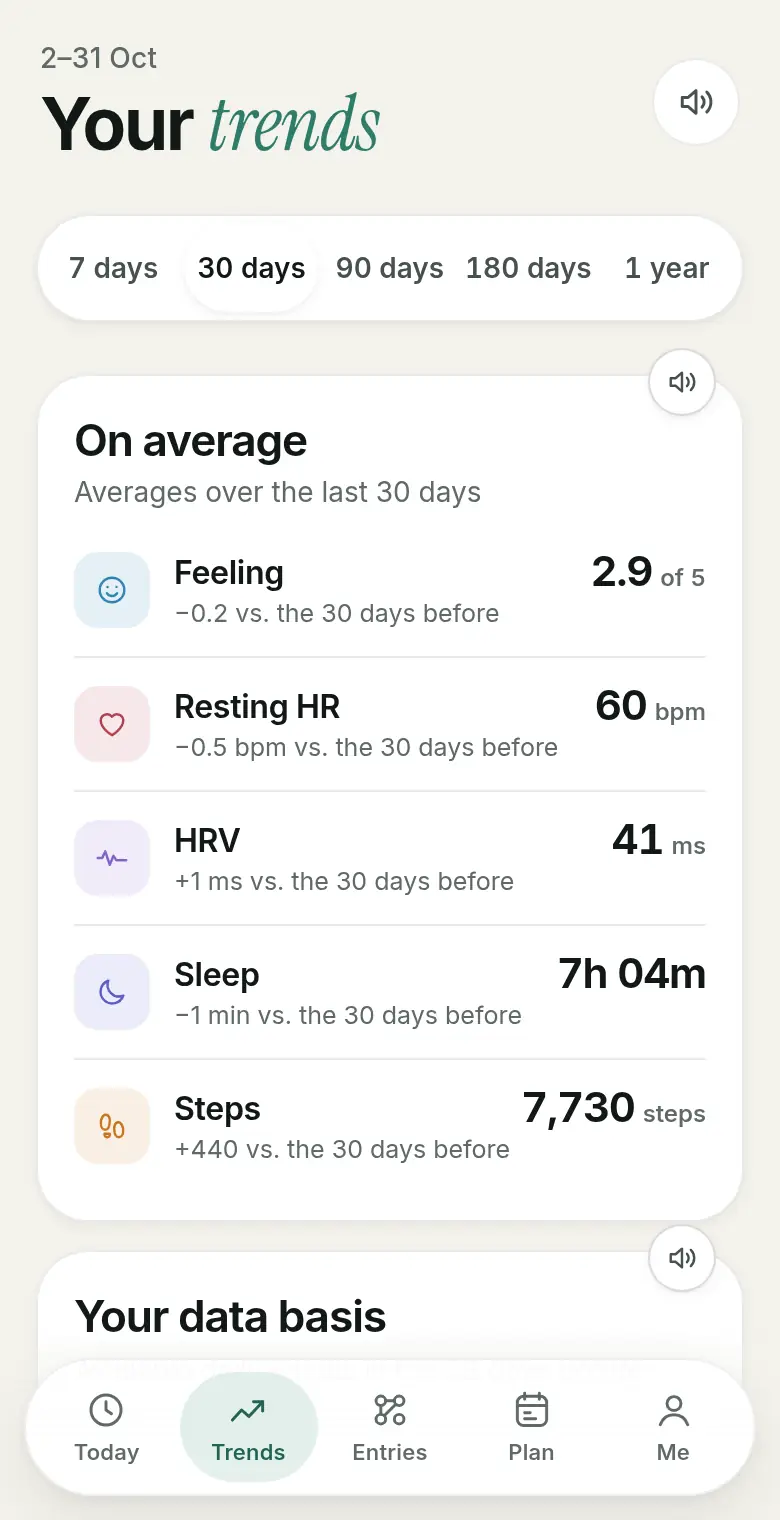
In mypacing, HRV is one of three values in the daily picture, together with resting heart rate and sleep. It is compared with your usual range over the last four weeks and described – without thresholds, without warnings, without a score.
Under “Entries”, the “Weekly rhythm” shows your feeling and your steps on average per weekday, each with the number of days. This is an observation – not a connection, not a cause and not an assessment. Where the values come from is explained in the guides on Apple Health and Health Connect.
Is there a good HRV value?
There is no single number that applies to everyone. Cleveland Clinic points out that HRV decreases with age and that a value that is normal for one person may not be normal for another (accessed 31.10.2026). Its clinical classification refers to SDNN over 24 hours. Short or overnight measurements from a watch cannot be compared with that directly.
| SDNN | RMSSD | |
|---|---|---|
| Calculation | Standard deviation of the intervals between normal heartbeats | Root mean square of successive differences between intervals |
| Used by | Apple Health | Health Connect, many watches, rings and apps |
| Unit | milliseconds | milliseconds |
In everyday terms: compare your HRV with your own usual range, from the same source and over several weeks.
Frequently asked questions
What is a good HRV?
It is individual. HRV depends on age, timing of the measurement and the calculation method, among other things. Your own trend from the same source says more than a number from a table.
What does a single low HRV reading mean?
On its own, not much. HRV varies considerably from day to day, for example after short nights, training or travel. Looking over weeks shows more.
Why do Apple Watch and other watches show different HRV values?
Apple Watch stores HRV as SDNN, while many other devices use RMSSD. Measurement times differ too. That is why the values cannot be compared directly.
Where does mypacing get HRV from?
From Apple Health on iPhone or Health Connect on Android, if your watch writes the value there and you allow reading. More in finding values in Apple Health and setting up Health Connect.
Read more
Resting heart rate over time
What resting heart rate is, why it varies from day to day, and what your usual range shows.
Apple Health: finding your values
Find the values in the Health app, understand the sources, and give mypacing access to individual values.
Planning recovery
Shift work, exam season, recreational sport and getting back into everyday life – with examples from the day plan.
Recovery after training
Read resting heart rate, HRV and sleep after hard training days and understand what manufacturers’ recovery time and training load calculate.
See mypacing: The demo shows the daily picture, history and day plan with made-up values – no account needed. More on the home page.
mypacing is not a medical device. The app shows your own values and notes over time. It does not make diagnoses, give treatment recommendations or replace medical advice.
The app is free on the App Store for iPhone and iPad and on Google Play for Android.
Publisher: SIGAtech Softwareentwicklung, responsible for content: Siegfried Gaier (legal notice). Last updated on 7 November 2026.